The US Built an Ebola Response Network. Why Isn't It the Center of the Current Response?
As the Ebola outbreak in the Democratic Republic of the Congo and Uganda grows, this commentary examines why sustained investment in NETEC and the National Special Pathogen System remains essential for US preparedness.
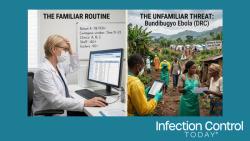
Back in 2014, working as infection preventionists (IPs) at a 100-bed community hospital in East Los Angeles, my colleagues and I spent months preparing for the possibility of an Ebola patient deplaning from the airport a few miles away and walking into our emergency department. We trained. We drilled. We spent hours perfecting the complex donning and doffing steps until it all began to feel like second nature. We identified our isolation room, reviewed our protocols, and ensured our team could perform under pressure. We continued to practice and drill until the CDC declared the threat officially over (Image).
During our first mock drill, we made a decision that has stayed with me ever since.
Even after all the preparation, we recognized the reality of what it meant to have a suspected Ebola patient present to our facility. The best, and only feasible, course of action was to isolate them and transfer out. Not because we hadn’t prepared, but because we were honest with ourselves about the gap between what a community hospital can safely provide and what a patient with a high-consequence hemorrhagic fever actually needs. That outbreak taught us a collective, real-time lesson in just how ill-equipped most facilities were to treat Ebola patients and protect frontline staff.
As a nation, we had to reconcile the cost of treating patients with a pathogen we were not fully prepared for.
Building the US’s Special Pathogen Shield
The National Emerging Special Pathogens Training and Education Center (NETEC) was established in 2015, born directly from the lessons of that outbreak. NETEC built the architecture for what is now the National Special Pathogen System (NSPS): a tiered network of health care facilities designed to ensure that every region in the US has access to a Level 1 Regional Emerging Special Pathogen Treatment Center (RESPTC), a facility with the clinical expertise, biocontainment infrastructure, and trained workforce to care for a patient with a high-consequence infectious disease for the full duration of their illness.1 Currently, 13 Level 1 RESPTCs operate across the country, coordinated by NETEC and funded by Congress (Figure 1).1
The NSPS exists because we learned a painful lesson: Readiness cannot be improvised. You do not build biocontainment capability in the middle of a crisis. You build it beforehand. You test it, fund it, and maintain it. When the call comes, you must know exactly how to activate it. That is what NETEC and the NSPS represent. They are the result of a decade of deliberate investment in the infrastructure that an Ebola case demands.
NETEC was built for this moment.


A Shield Without a Strategy
Now more than a month into the current outbreak, the Bundibugyo strain of Ebola circulating in the Democratic Republic of the Congo (DRC) and Uganda has produced 1,274 confirmed cases in the DRC and 20 in Uganda as of June 29.2 It is the second largest Ebola outbreak ever recorded in the DRC and the third largest documented globally.3 It is moving fast, with no licensed vaccine or antiviral treatment to slow it.4
This is exactly the scenario NETEC was built for, and precisely what the US’s biocontainment network has spent the last decade training to confront. Yet the federal response has leaned away from that network, not toward it. A Title 42 order now bars foreign nationals who have been in the DRC, Uganda, or South Sudan within the past 21 days from entering the US; returning citizens are routed through designated airports for enhanced screening.2,5
For US citizens already in the outbreak zone, the government has published a voluntary assistance process (Figure 2). Read it closely, and the direction is unmistakable: It points outward, not towards home. An exposed but asymptomatic citizen may be transported to a quarantine facility in Kenya for a 21-day monitoring period. A citizen who tests positive may be evacuated, in the guidance’s own words, to “a designated safe location for appropriate treatment.”6 Where that location is, the document never says.
That phrase is the heart of the problem. It is not a ban on bringing US citizens home: It is a refusal to commit to one. Secretary of State Marco Rubio captured the early posture in May: “We cannot and will not allow any cases of Ebola to enter the United States.”7 He later softened the line.8 However, the written process still names no destination, and the practice so far has pointed abroad: The only US citizen to test positive in this outbreak was evacuated to Germany, not home.9
When US citizen health care workers deployed to West Africa in 2014, they went knowing the answer to 1 question: If they fell ill, they would be brought home to a specialized US biocontainment unit.10 A decade later, that answer is a phrase that designates nothing.
Congress has pressed for the specifics, without a public answer. A June 9 letter pressed the administration on its readiness for the outbreak.11 On June 22, Senator Chuck Schumer (D-NY), the Senate Democratic leader, followed up with a letter to Secretaries Rubio and Kennedy demanding that the administration publicly release an Ebola response plan: one that would name a chain of command and spell out a protocol for treating US citizens who are infected or showing symptoms abroad.12 Neither has given a public reply. For now, there is no publicly released plan for where a sick US citizen would be treated.
Kenya and the Mirage of the New Shield
The offshore option the policy leaned on has since collapsed. After the Title 42 order took effect, officials announced a forward staging facility: a 50-bed quarantine unit at Laikipia Air Base in Kenya, established to receive and monitor Americans evacuated from the DRC and Uganda.13
Then the legal challenges came. Kenya’s High Court suspended construction. Work continued anyway. The Kenyan Health Cabinet Secretary was found in contempt, and construction was halted by June 23.14,15 The facility’s expansion is now frozen, and no replacement has been publicly identified.
NETEC: The Local Shield
The risk to the general US public remains low, and the CDC has assessed it as such. A recent study in Eurosurveillance found that across 50 years of documented Ebola outbreaks, researchers confirmed only 28 cases outside Africa.16 Excluding medically evacuated patients, the crude exportation risk since 2000 works out to 0.17 cases outside Africa per 1,000 reported in Africa.16 Nearly all of those cases involved known occupational exposures among health care workers and response personnel.16
That baseline, however, is not static. On June 24, French authorities confirmed an imported case in a humanitarian medical worker who had been in the DRC, self-reported symptoms upon arrival, and was immediately isolated.3,9 No US exposures have been linked to that case, and CDC has confirmed there is no indication of community transmission.3
On June 26, the CDC raised its Ebola response to a Level 1 activation, the agency’s highest level of emergency response, prompted by the urgency, scale, and complexity of the outbreak.3 A Level 1 activation signals across the entire agency that this is the top priority and authorizes the mobilization of staffing and resources from throughout the CDC.3
For patients already on US soil, the plan is unchanged. They will remain isolated at a frontline facility and be safely transferred to a designated NSPS facility as needed.
Additional Resources
NETEC Ebola Preparedness Webinar: July 28, 2026
A timely discussion on practical strategies to strengthen health care readiness for Ebola virus disease and other high-consequence infectious diseases (HCIDs). July 28, 2026, 11:00 a.m. ET. Registration via NETEC Education and Training.
NETEC Ebola Resource Library
Clinical guidance, preparedness resources, and educational materials compiled and updated by NETEC for the current outbreak. Includes infection prevention and control recommendations, PPE protocols, decedent management guidance, clinical evaluation tools, and exercise templates. Available via the NETEC Ebola Resource Library.
Find Your NSPS Level 1 Facility (RESPTC)
Contact information for all 13 Regional Emerging Special Pathogen Treatment Centers, organized by HHS region. Includes state and local health partner contacts, and physician, nursing, and operations leadership at each facility. Available via the NETEC National Special Pathogen System directory (Figure 1).
References
- National Emerging Special Pathogens Training and Education Center (NETEC). National Special Pathogen System. Accessed June 30, 2026. https://netec.org/nsps/
- Ebola disease: Current situation. CDC. Accessed June 30, 2026. Updated June 29, 2026. https://www.cdc.gov/ebola/situation-summary/index.html
- Transcript: Update on Ebola outbreak in the Democratic Republic of the Congo and Uganda. CDC. June 26, 2026. Accessed June 30, 2026. https://www.cdc.gov/media/releases/2026/transcript-update-on-ebola-outbreak-in-the-democratic-republic-of-the-congo-and-uganda-6-26-26.html
- Ebola disease caused by Bundibugyo virus, Democratic Republic of the Congo and Uganda. Disease Outbreak News World Health Organization. June 19, 2026. Accessed June 30, 2026. https://www.who.int/emergencies/disease-outbreak-news/item/2026-DON608
- What travelers need to know about returning to the United States from the DRC, Uganda, and South Sudan. CDC. Accessed June 30, 2026. https://www.cdc.gov/ebola/situation-summary/returning-travelers.html
- Additional consular information for Americans regarding the Ebola outbreak. US Department of State. Accessed June 30, 2026. https://travel.state.gov/en/international-travel/travel-advisories/global-events/ebola_additional_information.html
- Rubio insists no Ebola cases will be allowed in the US. Associated Press. May 27, 2026. Accessed June 30, 2026. https://apnews.com/video/rubio-insists-no-ebola-cases-will-be-allowed-in-the-us-b1aa25fafff64462abb758f059174d68
- Why there’s a debate over the new quarantine center for Americans at risk of Ebola. NPR. June 9, 2026. Accessed June 30, 2026. https://www.npr.org/2026/06/09/nx-s1-5850708/ebola-quarantine-u-s-citizens-kenya
- Ebola disease outbreak in the Democratic Republic of the Congo and Uganda. European Centre for Disease Prevention and Control. June 26, 2026. Accessed June 30, 2026. https://www.ecdc.europa.eu/en/ebola-outbreak-democratic-republic-congo-and-uganda
- Kuppalli K, Spencer C, Cetron M, Houry D. The US Ebola response and the future of global health leadership. Lancet. Published online June 29, 2026. Accessed June 30, 2026. doi:10.1016/S0140-6736(26)01291-2
- Kaine T, Murray P, Warnock R, et al. Letter to Secretary Rubio re: Ebola and hantavirus outbreaks. June 9, 2026.
- Schumer CE. Letter to Secretary Rubio and Secretary Kennedy re: Ebola response plan. June 22, 2026. Accessed June 30, 2026. https://www.democrats.senate.gov/imo/media/doc/schumer_letter_to_rubio_and_kennedy_re_ebola_plan.pdf
- Ebola response update, May 29, 2026. US Department of State. Accessed June 30, 2026. https://www.state.gov/releases/office-of-the-spokesperson/2026/05/ebola-response-update-may-29-2026
- Al Jazeera. Kenya minister says US-run Ebola facility plans halted after court order. June 23, 2026. Accessed June 30, 2026. https://www.aljazeera.com/news/2026/6/23/kenya-minister-says-us-run-ebola-facility-plans-halted-after-court-order
- Construction of US-backed Ebola facility in Kenya halted, minister says. CNBC Africa. Reuters. June 23, 2026.Accessed June 30, 2026. https://www.cnbcafrica.com/2026/construction-of-us-backed-ebola-facility-in-kenya-halted-minister-says
- van Zandvoort K, Procter SR, Azam JM, Sherratt K, Davies NG. The risk of global Ebola virus spread is low: Epidemiology of Ebola disease cases outside Africa, 1976 to May 2026. Euro Surveill. 2026;31(24):2600508. doi:10.2807/1560-7917.ES.2026.31.24.2600508